
Fiber optic cable has become an essential part of modern network infrastructure. As businesses require faster data transmission, greater bandwidth, and reliable connectivity across buildings and floors, fiber optics provides a powerful solution for enterprise networks.
For organizations planning a new network installation, infrastructure upgrade, or building-to-building connection, understanding the basics of fiber optic cable is an important first step.
What Is Fiber Optic Cable?
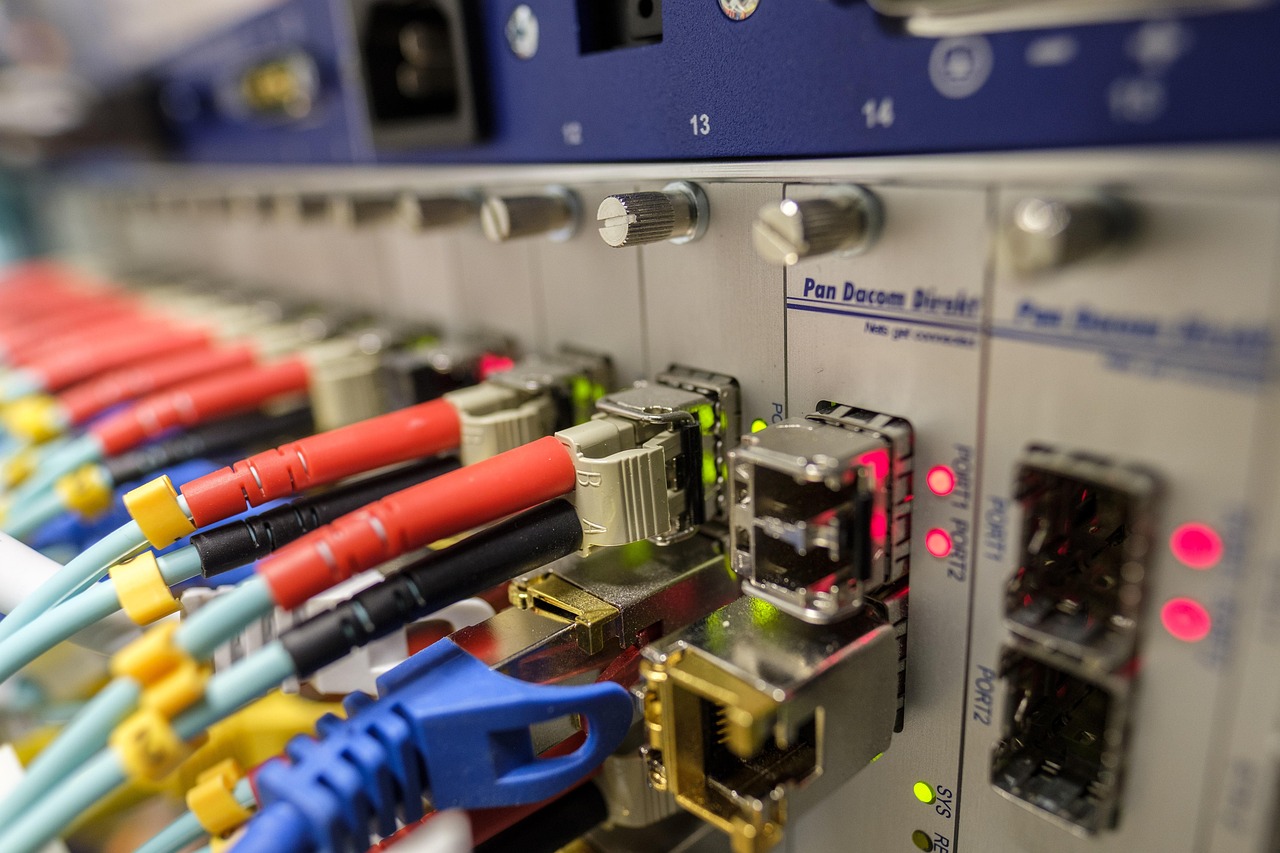
Fiber optic cable is a type of network cable that transmits data using pulses of light through very thin strands of glass or plastic fiber.
Unlike traditional copper Ethernet cables, such as Cat5e, Cat6, and Cat6A, fiber optic cables do not transmit data using electrical signals.
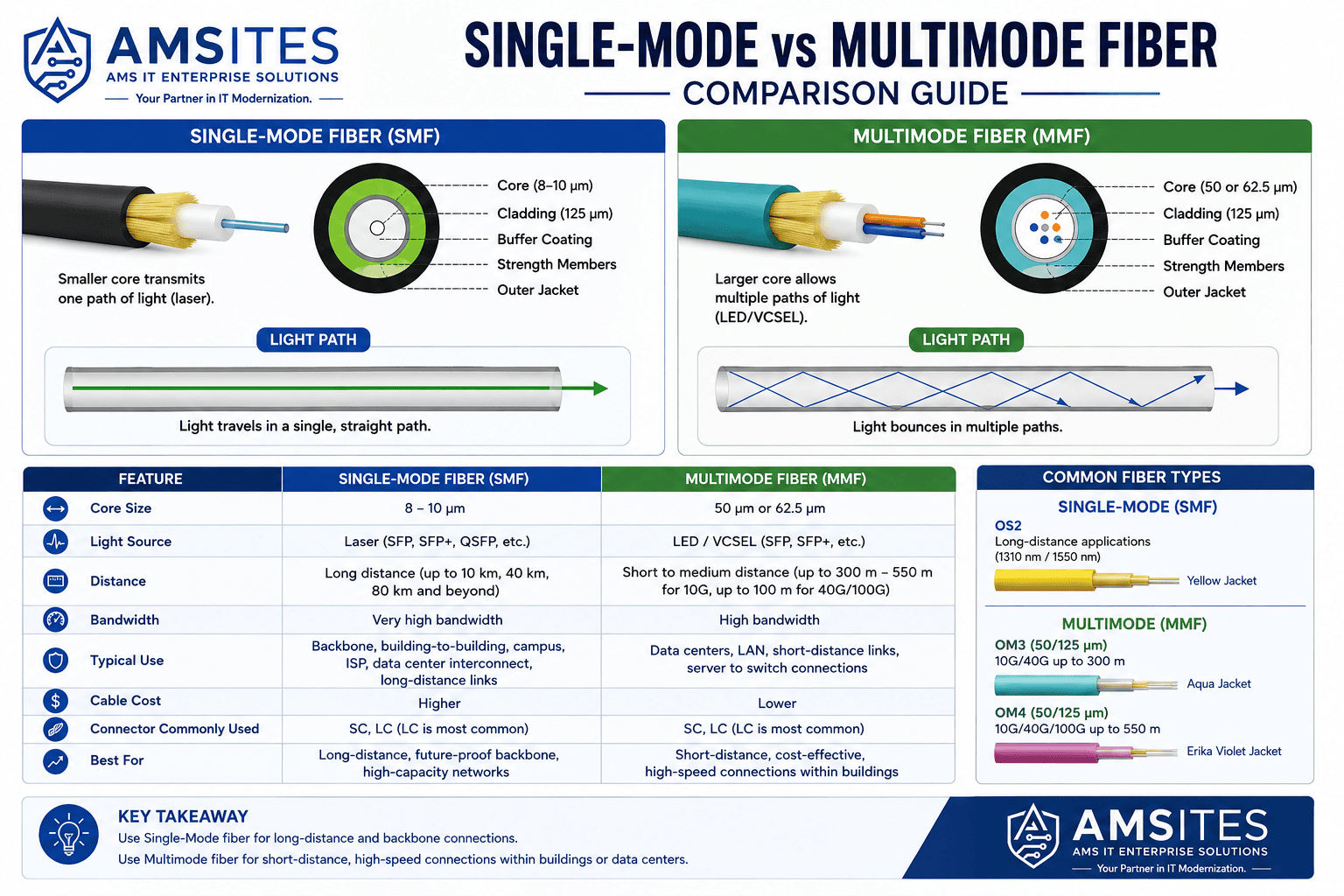
A typical fiber optic cable consists of several components, including:
- Core – The central part where light travels.
- Cladding – Surrounds the core and keeps the light contained within the fiber.
- Coating – Protects the fiber from moisture and physical damage.
- Strength members – Provide additional mechanical protection.
- Outer jacket – Provides overall protection for the cable.
This construction allows fiber optic cables to transmit large amounts of data over significantly longer distances than conventional copper cabling.
How Does Fiber Optic Cable Work?
The basic principle is relatively simple. A network device converts electrical data into light signals. These light pulses travel through the fiber core and are then converted back into electrical data at the receiving network device.
The basic principle is relatively simple. A network device converts electrical data into light signals. These light pulses travel through the fiber core and are then converted back into electrical data at the receiving network device.
Fiber Optic vs. Copper Cable
Both fiber and copper have important roles in modern network infrastructure.
Both fiber and copper have important roles in modern network infrastructure.
Feature | Fiber Optic | Copper Ethernet |
Transmission | Light | Electrical signal |
Distance | Long-distance capable | Generally shorter |
Bandwidth | Very high | High |
EMI Resistance | Excellent | Can be affected by interference |
Physical Size | Generally lightweight | Generally larger/heavier |
Typical Use | Backbone/uplinks | Workstations/access devices |
Cost | Usually higher | Usually lower |
Single-Mode vs. Multimode Fiber
One of the most important decisions when designing a fiber optic network is choosing between single-mode fiber (SMF) and multimode fiber (MMF).
Single-Mode Fiber
Single-mode fiber uses a very small core and is designed to carry light over long distances.
It is commonly used for:
- Building-to-building connections
- Campus networks
- Long-distance backbone connections
- Data center interconnections
- High-speed network backbones
OS2 is a common single-mode fiber specification used for modern backbone infrastructure.
Multimode Fiber
Multimode fiber has a larger core and is commonly used for shorter-distance applications.
It can be suitable for:
- Data centers
- Server rooms
- Building networks
- Short-distance high-speed connections
The appropriate fiber type depends on factors such as distance, required bandwidth, transceiver availability, infrastructure design, and future expansion requirements.
What Is an OS2 Fiber Cable?
OS2 is a single-mode fiber specification commonly used for long-distance and high-performance network infrastructure.
What Are LC and SC Connectors?
Fiber optic cables require specialized connectors to connect the fiber to network equipment and fiber panels.
Two commonly encountered connector types are LC and SC.
Fiber optic cables require specialized connectors to connect the fiber to network equipment and fiber panels.
Two commonly encountered connector types are LC and SC.
LC Connector
LC connectors are compact and commonly used in modern network equipment, fiber patch panels, and SFP/SFP+ connections.
SC Connector
SC connectors are larger than LC connectors and have traditionally been used in various telecommunications and fiber installations.
For modern enterprise network infrastructure, LC connectors are commonly preferred because of their compact size and compatibility with many SFP/SFP+ interfaces.
SC connectors are larger than LC connectors and have traditionally been used in various telecommunications and fiber installations.
For modern enterprise network infrastructure, LC connectors are commonly preferred because of their compact size and compatibility with many SFP/SFP+ interfaces.
Why Businesses Use Fiber Optic Cable
There are several reasons organizations deploy fiber optic infrastructure.
There are several reasons organizations deploy fiber optic infrastructure.
1. High Bandwidth
Fiber can support high-speed network connections and provides a strong foundation for future network upgrades.
Fiber can support high-speed network connections and provides a strong foundation for future network upgrades.
2. Long-Distance Transmission
Fiber is ideal for connecting locations separated by significant distances, including different floors, buildings, or facilities.
Fiber is ideal for connecting locations separated by significant distances, including different floors, buildings, or facilities.
3. Resistance to Electromagnetic Interference
Because fiber transmits data using light rather than electrical signals, it is highly resistant to electromagnetic interference.
Because fiber transmits data using light rather than electrical signals, it is highly resistant to electromagnetic interference.
4. Scalable Infrastructure
Installing the appropriate fiber backbone during an infrastructure project can provide capacity for future network upgrades.
Installing the appropriate fiber backbone during an infrastructure project can provide capacity for future network upgrades.
5. Reliable Backbone Connectivity
Fiber is well suited for connecting core and distribution network infrastructure where high-performance and stable connectivity are important.
Fiber is well suited for connecting core and distribution network infrastructure where high-performance and stable connectivity are important.
Where Is Fiber Optic Cable Commonly Used?
Fiber optic infrastructure can be found in many environments, including:
- Corporate offices
- Industrial facilities
- Warehouses
- Data centers
- Schools and universities
- Hospitals
- Hotels
- Government facilities
- Telecommunications networks
- Multi-building campuses
It is particularly useful when network equipment needs to be connected across different floors or buildings.
Fiber optic infrastructure can be found in many environments, including:
- Corporate offices
- Industrial facilities
- Warehouses
- Data centers
- Schools and universities
- Hospitals
- Hotels
- Government facilities
- Telecommunications networks
- Multi-building campuses
It is particularly useful when network equipment needs to be connected across different floors or buildings.
What Equipment Is Needed for a Fiber Installation?
A typical fiber optic backbone installation may include:
- Fiber optic cable
- Fiber patch panel or ODF
- Fiber adapters
- Fiber pigtails
- Fusion splices
- LC-LC fiber patch cords
- SFP/SFP+ transceivers
- Fiber management accessories
- Rack-mounted equipment
- Fiber testing equipment
The exact requirements depend on the network architecture and installation design.
A typical fiber optic backbone installation may include:
- Fiber optic cable
- Fiber patch panel or ODF
- Fiber adapters
- Fiber pigtails
- Fusion splices
- LC-LC fiber patch cords
- SFP/SFP+ transceivers
- Fiber management accessories
- Rack-mounted equipment
- Fiber testing equipment
The exact requirements depend on the network architecture and installation design.
Do You Always Need Fiber?
Not necessarily.
For a short connection between a network switch and workstation, Cat6 or Cat6A may be the more practical and cost-effective choice.
Fiber becomes particularly attractive when you need:
- Longer transmission distances
- High-speed backbone connectivity
- Building-to-building connections
- Floor-to-floor backbone connections
- High bandwidth
- Resistance to electromagnetic interference
- A scalable infrastructure for future upgrades
A properly designed network often uses fiber for the backbone and copper for end-user connections.
Not necessarily.
For a short connection between a network switch and workstation, Cat6 or Cat6A may be the more practical and cost-effective choice.
Fiber becomes particularly attractive when you need:
- Longer transmission distances
- High-speed backbone connectivity
- Building-to-building connections
- Floor-to-floor backbone connections
- High bandwidth
- Resistance to electromagnetic interference
- A scalable infrastructure for future upgrades
A properly designed network often uses fiber for the backbone and copper for end-user connections.
Why Proper Fiber Design Matters
Installing fiber optic cable is not simply a matter of pulling a cable between two locations.
The design should consider:
- Required bandwidth
- Distance
- Fiber type
- Connector type
- Number of fiber cores
- Network equipment compatibility
- SFP/SFP+ transceiver specifications
- Cable routing
- Bend radius
- Fiber termination
- Splicing requirements
- Testing and certification
- Future expansion
Poor planning can result in unnecessary costs or an infrastructure that becomes difficult to expand later.
Installing fiber optic cable is not simply a matter of pulling a cable between two locations.
The design should consider:
- Required bandwidth
- Distance
- Fiber type
- Connector type
- Number of fiber cores
- Network equipment compatibility
- SFP/SFP+ transceiver specifications
- Cable routing
- Bend radius
- Fiber termination
- Splicing requirements
- Testing and certification
- Future expansion
Poor planning can result in unnecessary costs or an infrastructure that becomes difficult to expand later.
Conclusion
Fiber optic cable is an important component of modern business network infrastructure. With its high bandwidth, long-distance capabilities, and resistance to electromagnetic interference, fiber provides an excellent foundation for network backbones and high-speed connectivity.
For businesses planning a new network installation or infrastructure modernization project, the right fiber solution should be selected based on the organization's current requirements and future growth plans.
At AMS IT Enterprise Solutions (AMSITES), we help businesses plan and implement network infrastructure solutions, including structured cabling and fiber optic backbone deployments.
Need help designing your fiber optic network infrastructure?
Contact AMSITES – Your Partner in IT Modernization for a consultation and project assessment.
Fiber optic cable is an important component of modern business network infrastructure. With its high bandwidth, long-distance capabilities, and resistance to electromagnetic interference, fiber provides an excellent foundation for network backbones and high-speed connectivity.
For businesses planning a new network installation or infrastructure modernization project, the right fiber solution should be selected based on the organization's current requirements and future growth plans.
At AMS IT Enterprise Solutions (AMSITES), we help businesses plan and implement network infrastructure solutions, including structured cabling and fiber optic backbone deployments.
Need help designing your fiber optic network infrastructure?
Contact AMSITES – Your Partner in IT Modernization for a consultation and project assessment.